To choose a sweater manufacturer in China, check five things in order: the machines and gauges it owns, the MOQ per style and colour, sampling speed and rounds, the written AQL inspection standard, and the payment terms. A factory that answers all five in writing, with photos or video, is worth a sample order.
Key takeaways
- Ask for the machine list by gauge, not just "we have 100 machines". Gauge decides which sweaters a factory can make well.
- A realistic small-batch MOQ for knitwear is 100–300 pieces per style. Jiameidi starts at 100 pcs across up to 2 colours and 3 sizes.
- First samples should take about one working week. Bulk usually takes 20–40 working days after approval.
- Insist on a written inspection standard such as ISO 2859-1 with AQL 2.5 for major defects and 4.0 for minor defects.
- Never pay 100% up front. A 30% deposit and a 70% balance before inspection is the common pattern.
Why choosing a sweater factory is different from other clothing
Sweaters are not cut and sewn from fabric. Each panel is knitted to shape on a flat-knitting machine, then linked stitch by stitch. That means the factory’s machines, its linking team and its finishing (washing and steaming) decide the result more than its sewing line. A cut-and-sew factory that “also does knitwear” often subcontracts the knitting, and you lose control of quality and timing.
This is why the first question is always about equipment. A factory with mostly 12G machines will struggle with chunky 3G cardigans. A factory with mostly 7G machines may be the wrong choice for fine 14G layering tops.
The 10-point checklist
Use this list on your first video call or email. Ask for proof, not promises.
- Machine list by gauge. Ask how many machines they run at 3G, 5G, 7G, 12G and 14G. At our Dongguan factory, the split is 10 × 3G, 10 × 5G, 50 × 7G, 40 × 12G and 10 × 14G, for 120 computerized flat-knitting machines.
- In-house knitting, linking and finishing. Ask which steps happen under one roof. Subcontracted linking is a common source of open seams.
- Capacity versus your order. A factory that makes 60,000 sweaters a month can fit a 300-piece order. A 20-machine workshop may not fit 20,000 pieces in your window.
- MOQ per style, colour and size. Get the MOQ in writing, including how many colours and sizes it can be split across.
- Sample lead time and rounds. Ask how many working days a first sample takes and how many revision rounds are included.
- Sample fee and refund rule. Many factories refund the sample fee once the bulk order passes a set quantity.
- Written QC standard. Ask for the inspection checkpoints and the AQL levels. See how we document this on our quality control page.
- Size tolerance. A typical finished-measurement tolerance for knitwear is ±1.5–2 cm. Agree it before bulk.
- Payment terms. Watch for 100% prepayment requests, or payment to a personal account.
- References and repeat business. Ask for anonymised case studies with quantities, lead times and pass rates.
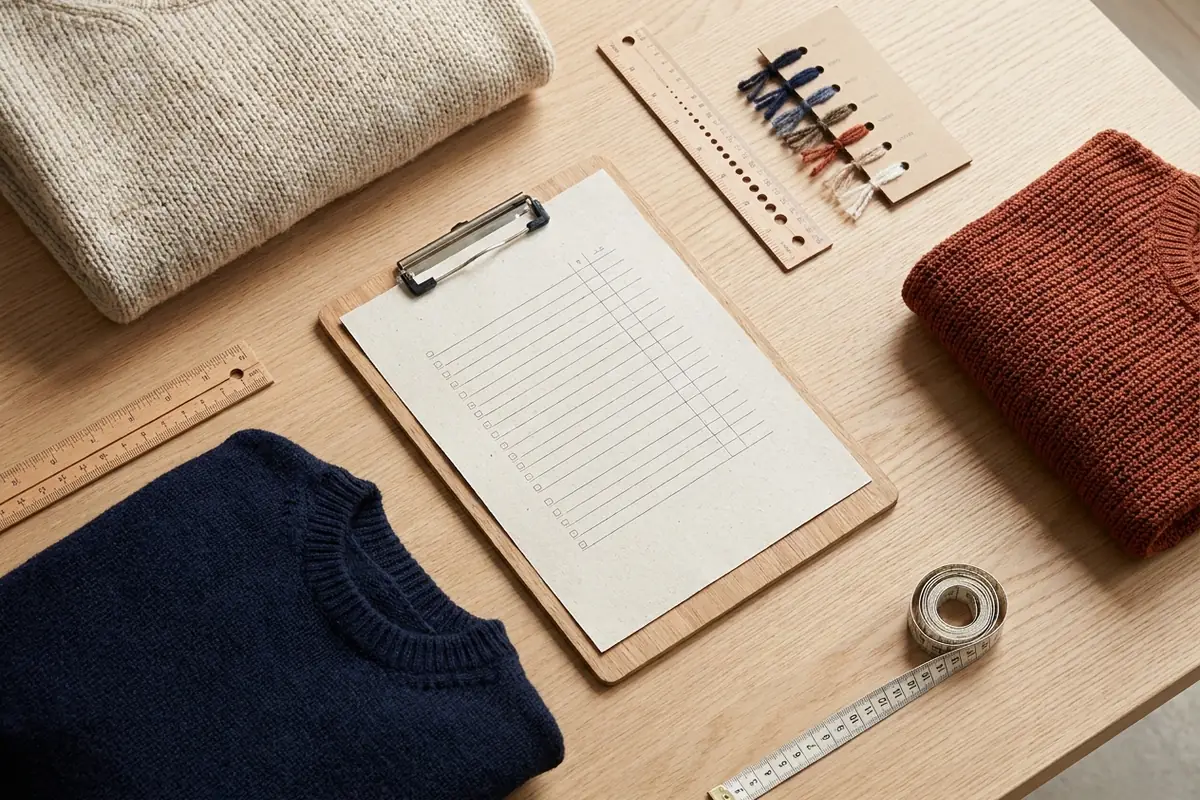
Decision table: what a good answer looks like
| Question | Good answer | Red flag |
|---|---|---|
| Machines by gauge | A list with counts per gauge | “We can do any gauge” |
| MOQ | 100–300 pcs per style, split rules stated | No MOQ given until you pay a fee |
| First sample | 3–7 working days | “2–3 weeks” for a simple jersey style |
| Revisions | 2–3 rounds included | Every change re-quoted |
| QC standard | ISO 2859-1, AQL 2.5 major / 4.0 minor | “We check everything 100%” with no record |
| Size tolerance | ±1.5–2 cm agreed in writing | Not discussed |
| Payment | 30% deposit / 70% before inspection | 100% before production |
| Shipping terms | FOB or EXW stated, DDP evaluated | Only “door to door” with no breakdown |
What to look for on a factory video call
A 20-minute live video call tells you more than a polished catalogue. Ask the sales contact to walk from the yarn store to the packing area without cutting the stream. You are checking four things:
- Yarn storage. Cones should be labelled by lot and kept off the floor. Mixed, unlabelled cones are a warning sign for shade problems in bulk.
- Knitting floor. Ask them to point the camera at the gauge plate on a few machines. If most machines are 12G and your style is 5G chunky, you have your answer.
- Linking. Linking is skilled, manual work. Look for operators working at linking machines in good light, not panels piled on the floor waiting for “outside” workers.
- Finishing and QC. Look for a measuring table, size charts on the wall and garments being checked after steaming.
Also ask who will be your day-to-day contact during production, and whether that person can read a tech pack in English. Many delays come from translation gaps between the sales team and the sample room, not from the machines.
How to score factories: a simple calculation
Shortlist three factories and score each point 0, 1 or 2 (0 = no answer, 1 = verbal answer, 2 = written proof). The maximum is 20.
- 16–20: order a paid sample.
- 11–15: ask for the missing proof before sampling.
- 10 or less: move on.
Example: Factory A sends a gauge list (2), a QC document (2), an MOQ split rule (2) and photos of linking (2), but only gives a verbal size tolerance (1). If it scores 2 on the other five points, the total is 19 and it earns a sample order.
A first-party example: what a factory’s written answers look like
Here is how Jiameidi answers the checklist in writing, so you can compare it with others:
- Equipment: 120 computerized flat-knitting machines from 3G to 14G, 210 staff, 2,500 m² under one roof.
- MOQ: from 100 pcs per style across up to 2 colours and 3 sizes. Special yarns can raise it, and it is confirmed in the quote.
- Sampling: 3–7 working days, up to 3 revision rounds. The sample fee is refunded on bulk orders of 200 pcs or more.
- Bulk: 20–30 working days after sample approval and a 30% deposit.
- QC: five checkpoints, from incoming yarn to pre-shipment, with AQL 2.5 major and 4.0 minor per ISO 2859-1, Level II.
- Terms: FOB Shenzhen or EXW Dongguan. DDP is evaluated per order.
Our case studies show how this worked for three buyers: a German boutique brand (12G cashmere-blend pullovers, 98.5% bulk pass rate), a US e-commerce seller (7G basics, 98% pass rate) and a UK e-commerce brand (20,000–30,000 pcs a season). These are our own reported figures.
If you are starting your first collection, read How to Start a Sweater Brand with a 100-Piece MOQ before contacting factories.
What to send a factory in your first message
Factories answer faster and more accurately when the first message is complete. Include:
- Two or three reference photos, or your tech pack if you have one
- Target quantity per style and the number of colours and sizes
- Target market (US, UK or EU), because sizing and labelling differ
- Target retail price, so the factory can suggest the right yarn level
- Your timeline: when the goods must arrive
A short, complete brief often gets a sample quote within 24 hours instead of a week of back-and-forth questions.
Risk boundaries: what this checklist cannot tell you
- Certifications. A checklist cannot replace an audit. If your retailer requires BSCI, OEKO-TEX or similar, ask which certificates the factory holds today. Jiameidi does not currently hold BSCI or OEKO-TEX, and arranges third-party lab tests per order instead.
- Tariffs and duties. US duty on sweaters from China depends on the HTS code, fibre content and current trade measures, which changed several times in 2025–2026. Check the official Harmonized Tariff Schedule before you price.
- Fibre claims. A factory can label “cashmere blend”, but you are legally responsible for the fibre content label in your market.
- One sample is not bulk. Approve a pre-production sample from the bulk yarn lot whenever colour matters.
FAQ
What is a normal MOQ for a sweater manufacturer in China?
For small brands, most knitwear factories quote 100–300 pieces per style. Jiameidi starts at 100 pieces per style across up to 2 colours and 3 sizes. Complex yarns or techniques can raise the MOQ.
How long does it take to make a sweater sample?
A simple jersey or rib sweater usually takes 3–5 working days on computerized flat-knitting machines. Complex jacquard or cable styles take about 7 working days.
How can I check a sweater factory without visiting China?
Ask for a live video tour of the knitting, linking and finishing areas, a machine list by gauge, and a written QC standard. Then order a paid sample and, for bulk, book a third-party pre-shipment inspection.
Should I pay a sweater manufacturer 100% up front?
No. A common structure is a 30% deposit on order confirmation and a 70% balance before final inspection, so you see inspection results before goods ship.
What does AQL 2.5 mean for sweaters?
It is the acceptance quality limit for major defects in an ISO 2859-1 sampling plan. For a 281–500 piece lot, the inspector checks 50 pieces and accepts the lot with up to 3 major defects.
Planning an order?
Send us a style code or a photo. We reply within 24 hours with questions, a sample plan and a quotation.
Get a Free QuoteSources
- ISO 2859-1, Sampling procedures for inspection by attributes, International Organization for Standardization
- Harmonized Tariff Schedule of the United States, U.S. International Trade Commission
- Threading Your Way Through the Labeling Requirements Under the Textile and Wool Acts, U.S. Federal Trade Commission
Last reviewed 16 November 2026.