The cost to manufacture a sweater depends mainly on four things: how much yarn the finished garment uses, what that yarn costs per kilogram, how many machine and labour minutes the gauge and stitch need, and the order quantity. Trims, packing, testing and shipping terms come on top. Get these inputs right and any factory quote becomes predictable.
Key takeaways
- Yarn is usually the largest single cost in a sweater, so garment weight and fibre choice move the price most.
- Finer gauges (12G, 14G) take longer to knit than chunky gauges (3G, 5G), but use less yarn per garment.
- Jacquard, cable and intarsia add knitting time and programming work compared with plain jersey.
- Small orders cost more per piece because setup, sampling and yarn minimums are shared across fewer pieces.
- Always compare quotes on the same Incoterm. A FOB price and a DDP price are not the same number.
Why there is no single “sweater price”
A 12G cotton-viscose layering top and a 3G mohair-blend cardigan are both “sweaters”, but they share almost nothing in cost. The first uses a light yarn and many knitting minutes. The second uses a lot of expensive yarn and fewer minutes. That is why Jiameidi, like most knitwear factories, quotes per style based on yarn, gauge, quantity and customisation, with no fixed price list (see our terms of supply).
The cost formula
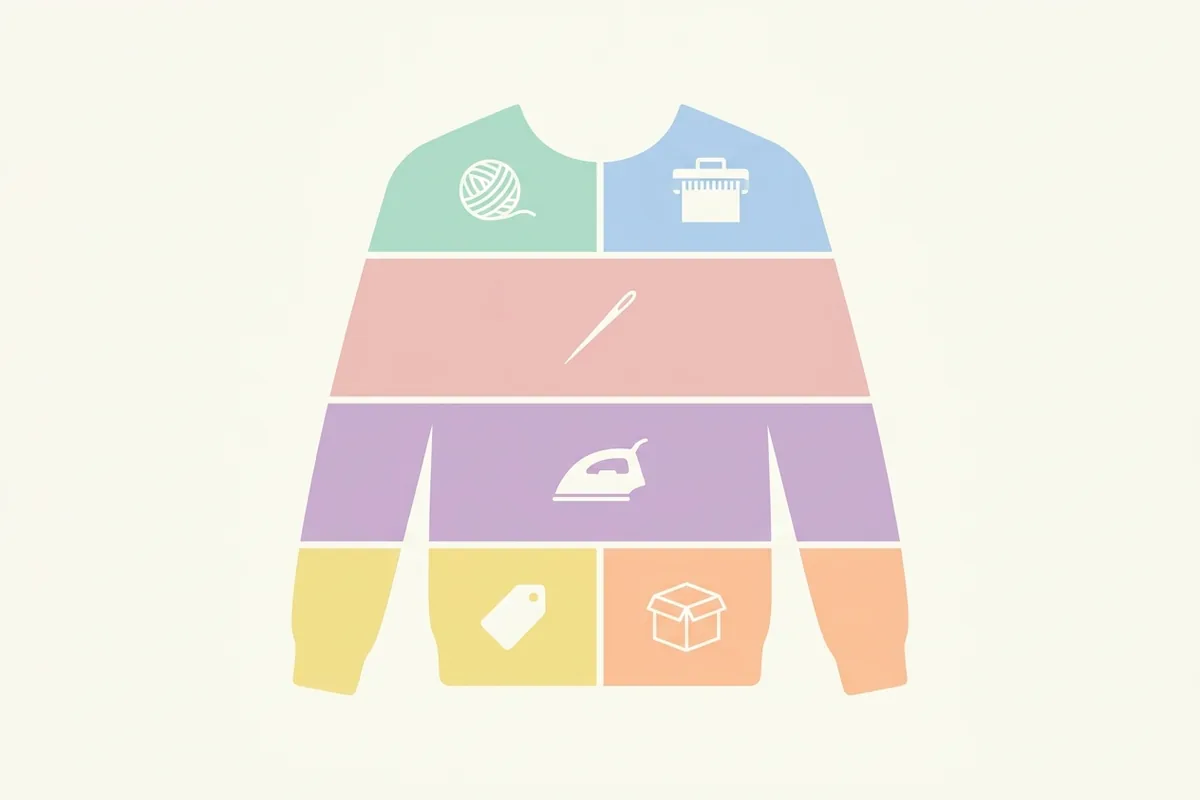
Most knitwear factories build a quote in this order:
- Yarn cost = finished garment weight × (1 + wastage) × yarn price per kg
- Knitting cost = machine minutes per garment × machine rate
- Make-up cost = linking + mending + washing + steaming + trimming
- Trims and branding = labels, hang tags, buttons, zips, patches
- Packing = polybag, barcode sticker, export carton share
- Overheads and margin
- Terms adjustment = inland freight to port (FOB), or freight, duty and delivery (DDP)
A worked example (illustrative numbers)
The numbers below are for illustration only, to show how the formula works. They are not a Jiameidi quote. Replace them with the figures from your own quotation.
Assume a women’s 7G crew-neck pullover in a wool-blend yarn:
- Finished weight: 450 g
- Wastage: 8%
- Yarn price: US$ Y per kg
Yarn cost = 0.45 kg × 1.08 × Y = 0.486 × Y
If you switch the same style to a 12G yarn and the finished weight drops to 300 g, yarn cost becomes 0.30 × 1.08 × Y = 0.324 × Y. That is about one third less yarn, but knitting time goes up because the machine makes more stitches per row.
This is the trade-off buyers often miss: a finer gauge is not automatically cheaper or more expensive. It moves cost from yarn to machine time.
What changes the quote: decision table
| Spec change | Effect on cost | Why |
|---|---|---|
| Acrylic → wool blend | Up | Higher yarn price per kg |
| Wool blend → cashmere blend | Up sharply | Precious fibre; quoted separately |
| 7G → 3G chunky | Usually up | Much heavier garment, more yarn |
| 7G → 12G fine | Mixed | Less yarn, more knitting minutes |
| Plain jersey → cable or jacquard | Up | Longer knitting time and programming |
| Add embroidery or beading | Up | Extra hand or machine process |
| 100 pcs → 500 pcs per style | Down per piece | Setup and sampling spread over more pieces |
| FOB → DDP | Up (on the invoice) | Freight, duty and delivery now included |
Our yarn and colour guide groups fibres by price level, from entry (acrylic, cotton) to high (cashmere and cashmere blends). Our knitting techniques page shows which stitches add the most time.
A first-party example: what is fixed and what moves
At Jiameidi, some terms are the same for every quote and others move with the spec:
- Fixed: MOQ from 100 pcs per style (up to 2 colours and 3 sizes), 30% deposit and 70% balance before final inspection, FOB Shenzhen or EXW Dongguan.
- Moves with spec: yarn, gauge, technique, trims and quantity. Special yarns can raise the MOQ.
- Sample fee: quoted per style, refunded when the bulk order reaches 200 pcs.
The practical tip: send two or three yarn options with your request. We usually suggest two or three yarns to sample based on your target retail price, so you can see the price difference before you commit.
How to read a factory quote
A useful quote lists the yarn composition, gauge, garment weight, MOQ, sample fee, bulk lead time and Incoterm. If any of these are missing, ask. A low price with “weight to be confirmed” often rises after sampling.
Also check whether the price is per piece at the MOQ or at a higher quantity, and whether tests and inspection are included.
Six ways to lower sweater cost without lowering quality
- Use stock-shade yarn. Custom-dyed yarn needs larger yarn lots and adds days. Stock shades from the spinner’s colour card are cheaper and faster, and they keep the MOQ low.
- Simplify the stitch, not the yarn. A plain jersey body with a cable placket often looks almost as rich as an all-over cable, at a fraction of the knitting time.
- Reduce garment weight by design. A slightly shorter body, a narrower sleeve or a lighter rib trim can remove 30–60 g of yarn per piece. On a wool blend, that adds up quickly.
- Share yarn across styles. If your pullover, cardigan and vest use the same yarn and colour, you buy yarn in one lot and reduce wastage.
- Keep trims simple. Custom buttons, woven badges and special zips each have their own minimums and lead times. Stock trims plus your own main label usually look just as good.
- Order at the next price break. Ask the factory where its price steps are, for example 100, 300 and 500 pieces. Sometimes 300 pieces cost little more in total than 200.
Questions to ask before you accept a quote
- What finished weight is this price based on, and what happens if the sample weighs more?
- Is the price for the MOQ quantity or a higher quantity?
- Which yarn supplier and composition are used, and is the yarn a stock shade?
- Are labels, hang tags, polybags and cartons included?
- Is pre-shipment inspection included? Who pays for third-party lab tests?
- Which Incoterm does the price use, and from which port?
- How long is the quote valid?
Write the answers into your purchase order. This avoids most price disputes after sampling.
From factory price to landed cost
The factory price is only part of what you pay. Your landed cost adds:
- Freight from Shenzhen to your port or warehouse
- Import duty, set by the HTS code (US), the UK Global Tariff or the EU Common Customs Tariff
- Customs brokerage and port fees
- Inland delivery
For the US, sweaters generally fall under HTS heading 6110 (jerseys, pullovers, cardigans, knitted). The duty rate depends on fibre content, and extra trade measures on Chinese-origin goods changed repeatedly in 2025–2026. The $800 de minimis exemption is also suspended, so small parcels no longer enter duty-free. Always check current rates before you set a retail price.
Price drivers specific to knitwear
Two cost factors are often missed by buyers coming from cut-and-sew:
- Linking time. Every seam on a sweater is linked loop by loop. Raglan sleeves, set-in sleeves and fully fashioned necklines each need different linking work, so construction choices change labour time.
- Washing and finishing. Wool blends, mohair and cashmere need gentler, slower finishing than acrylic. Special washes for softness add another step.
Ask the factory to show these lines separately if your quote is higher than expected. It is usually one of them, together with yarn weight.
When a higher price is the better deal
The lowest quote is not always the lowest cost. A slightly higher factory price can save money if it includes a written AQL inspection, a pre-production sample in bulk yarn, accurate measurements after washing and reliable delivery dates. One failed bulk order, or one season of returns for shrinkage or pilling, costs far more than a small difference in unit price.
Risk boundaries
- Don’t price from an average. Online “average sweater cost” figures mix very different yarns and gauges and will mislead you.
- Duty is your cost, not the factory’s, unless you buy DDP. Under FOB, the buyer pays import duty.
- Yarn markets move. Wool and cashmere prices change with each season’s fibre market, so quotes usually have a validity period.
- Exchange rates affect quotes in USD over a long development cycle.
FAQ
What is the biggest cost in making a sweater?
Usually yarn. Garment weight multiplied by yarn price per kilogram is the largest line in most knitwear quotes, especially for wool, mohair and cashmere blends.
Why does a 100-piece order cost more per sweater than 500 pieces?
Setup, programming, sampling and yarn ordering cost roughly the same for 100 or 500 pieces. With fewer pieces, each sweater carries a bigger share of those fixed costs.
Does a finer gauge make a sweater cheaper?
Not always. A 12G or 14G sweater uses less yarn than a 7G one of the same size, but it takes longer to knit. The final price depends on which effect is larger for your yarn.
Is FOB or DDP cheaper for sweaters?
The FOB price is lower on the invoice because it excludes freight and duty. DDP includes them. Compare landed cost, not the factory price, to see which is cheaper for you.
Are sweater samples free?
Usually not. Jiameidi quotes the sample fee per style and refunds it when the bulk order reaches 200 pieces or more.
Planning an order?
Send us a style code or a photo. We reply within 24 hours with questions, a sample plan and a quotation.
Get a Free Quote